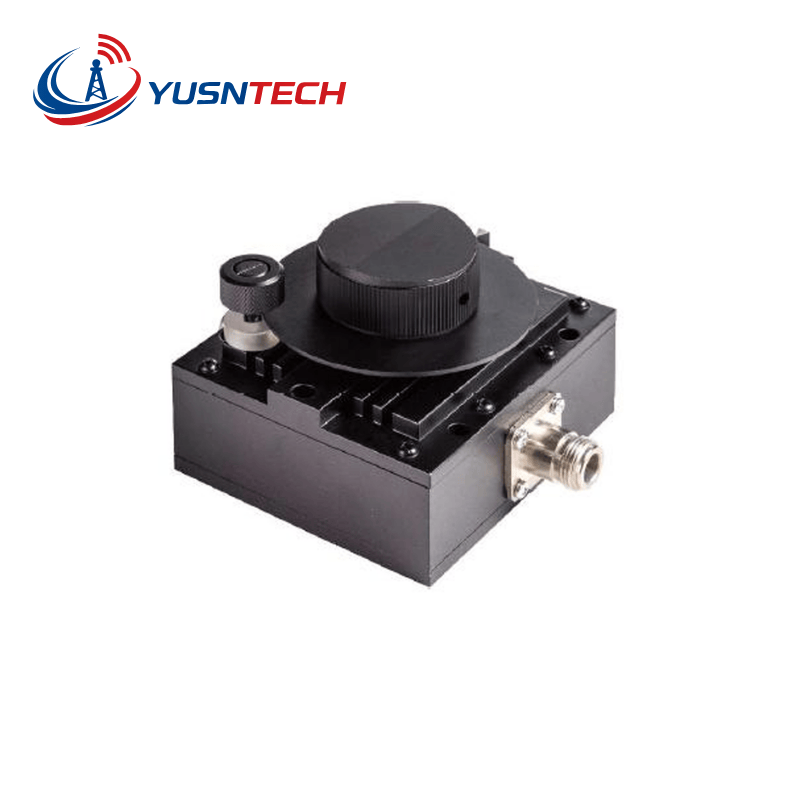
YUSNTECH Continuously Variable Attenuators (CVA) provide smooth, stepless RF signal attenuation across broad frequency ranges from DC to 18 GHz, with attenuation ranges up to 40 dB and power handling from 1 W to 300 W. Designed for precise signal level control, calibration, testing, and microwave system integration, these 50 Ω attenuators feature low insertion loss, excellent VSWR performance, and SMA or N-type connectors, making them ideal for RF test benches, communication systems, aerospace, defense, satellite, and laboratory applications.
Features
• Continuous attenuation adjustment • Wide attenuation range • Smooth and stable tuning performance • Broadband frequency coverage • Compact and easy-to-integrate design
Applications
• Real-time signal control • RF system optimization • EMC / EMI testing • Communication system tuning • Engineering development and testing
A Continuously Variable Attenuator (CVA) is an RF and microwave device that provides smooth, stepless attenuation adjustment across a specified frequency range. Unlike fixed attenuators or step attenuators, a CVA allows users to precisely control signal levels in real time, making it ideal for RF testing, calibration, communication systems, satellite applications, laboratory measurements, and microwave signal conditioning.
A continuously variable attenuator adjusts RF signal amplitude through a mechanical or electronic control mechanism that changes the attenuation level without discrete steps. This enables accurate signal power control, helping engineers optimize system performance, receiver sensitivity, dynamic range testing, and transmitter output verification across various RF and microwave applications.
A continuously variable attenuator provides smooth attenuation adjustment over its entire range, while a step attenuator changes attenuation in predefined increments such as 1 dB, 5 dB, or 10 dB steps. CVAs are preferred when fine signal tuning and precise calibration are required, whereas step attenuators are often used for repeatable test setups and automated measurement systems.
RF continuously variable attenuators are available from DC to microwave frequencies, with common models covering DC–2.5 GHz, 2–18 GHz, 8–12.4 GHz, 12.4–18 GHz, and other custom frequency bands. Wideband attenuators are widely used in wireless communication, radar, satellite communication, aerospace, defense, and RF laboratory environments.
Most continuously variable attenuators are available with attenuation ranges of 0–10 dB, 0–20 dB, 0–30 dB, and 0–40 dB. Custom attenuation ranges may also be provided depending on frequency band, power handling requirements, and application-specific performance needs.
Power handling capabilities vary significantly depending on design. Low-power models may support 1 W to 10 W, while high-power RF variable attenuators can handle 50 W, 100 W, 300 W, or higher. High-power attenuators are commonly used in transmitter testing, RF power amplifier development, radar systems, and satellite ground station applications.
Low VSWR minimizes signal reflections and impedance mismatch within RF systems. A high-quality continuously variable attenuator with low VSWR helps maintain signal integrity, improves measurement accuracy, reduces standing waves, and enhances overall system performance in test and communication environments.
RF continuously variable attenuators are widely used in RF and microwave test benches, communication system integration, signal level adjustment, receiver sensitivity testing, transmitter verification, radar development, satellite communications, electronic warfare systems, research laboratories, and production test environments.
Yes. Continuously variable attenuators are frequently used in satellite uplink and downlink systems to optimize signal levels, protect sensitive receivers, perform calibration procedures, and support system integration testing. Their precise attenuation control makes them valuable components in both commercial and military satellite communication networks.
Common connector options include SMA, N-Type, 2.92 mm, TNC, BNC, and other RF connector interfaces. The choice depends on operating frequency, power level, environmental requirements, and system compatibility. Higher power models typically use N-Type connectors due to their superior power-handling capability.
Selecting the correct attenuator requires evaluating frequency range, attenuation range, power handling, insertion loss, VSWR, connector type, environmental conditions, and mechanical configuration. For optimal system performance, the attenuator should provide sufficient attenuation range while maintaining low insertion loss and excellent impedance matching.
Industries that frequently use RF continuously variable attenuators include satellite communications, aerospace, defense, radar, telecommunications, wireless infrastructure, electronic warfare, semiconductor testing, research laboratories, universities, and RF equipment manufacturing.
Yes. High-power continuously variable attenuators are commonly used in RF power amplifier development and validation. They allow engineers to safely control signal levels, evaluate amplifier performance, perform gain compression testing, and protect sensitive downstream measurement equipment.
Many manufacturers offer custom RF attenuator solutions tailored to unique operating frequencies, attenuation ranges, connector types, power ratings, and mechanical configurations. Customization is particularly common for aerospace, military, satellite, and specialized microwave system applications.
YUSNTECH continuously variable attenuators are designed for precise RF signal control across broad frequency ranges, offering smooth stepless adjustment, low insertion loss, excellent VSWR performance, and power handling from low-power laboratory models to high-power microwave attenuators. They are suitable for RF testing, satellite communications, radar systems, wireless infrastructure, aerospace, defense, and custom microwave applications worldwide.
The price of a continuously variable attenuator depends on several factors, including frequency range, attenuation range, power handling capability, connector type, VSWR performance, insertion loss specifications, environmental requirements, and customization needs. High-power microwave attenuators and wideband RF attenuators generally require more complex designs and therefore have higher costs.
Yes. Custom quotations are available for projects requiring specific frequency bands, attenuation ranges, connector interfaces, power ratings, mechanical dimensions, or environmental specifications. Providing detailed technical requirements helps ensure accurate pricing and faster proposal turnaround.
Lead times vary depending on product complexity and order quantity. Standard continuously variable attenuators are often available with short delivery times, while custom RF attenuator solutions may require additional engineering and production time. Contacting the manufacturer directly is the best way to obtain current lead-time information.
Yes. OEM and ODM services are available for customers seeking private labeling, customized branding, special packaging, modified specifications, or application-specific RF and microwave attenuator solutions. OEM projects are commonly requested by distributors, system integrators, and equipment manufacturers.
Sample orders are typically available for evaluation and qualification purposes. Testing a sample RF variable attenuator allows engineers to verify performance, compatibility, and reliability before committing to larger production quantities.
Yes. Custom frequency coverage can often be developed for specific applications, including satellite communication bands, radar frequencies, military communication systems, test equipment, and specialized microwave platforms requiring non-standard frequency ranges.
Many RF attenuator manufacturers can provide custom attenuation ranges based on application requirements. Whether the project requires 0–10 dB, 0–20 dB, 0–40 dB, or a unique attenuation profile, customized solutions can often be engineered to meet system specifications.
Depending on customer requirements and application sectors, products may be supplied with manufacturing quality documentation, inspection reports, RoHS compliance, REACH compliance, and other relevant certifications. Certification availability may vary according to product type and destination market.
Yes. Electrical performance data such as insertion loss, VSWR, attenuation accuracy, frequency response, and inspection results can typically be supplied upon request. Test documentation helps customers verify product compliance before installation and deployment.
Yes. High-power RF attenuators can be customized according to operating frequency, power rating, connector type, cooling requirements, mechanical dimensions, and installation constraints. These solutions are widely used in radar, satellite communications, RF amplifier testing, and defense applications.
For the fastest quotation process, it is recommended to provide the required frequency range, attenuation range, power handling, connector type, operating environment, quantity, and any special mechanical or electrical requirements. Complete specifications help reduce engineering review time and improve quotation accuracy.
Yes. Many RF and microwave projects begin with prototype validation and low-volume production. Flexible manufacturing options can support both small engineering quantities and large-scale production requirements, helping customers accelerate product development and deployment.
In many cases, equivalent or replacement continuously variable attenuators can be designed to match existing frequency ranges, attenuation characteristics, connector interfaces, and mechanical dimensions. This helps extend system life cycles and reduce redesign costs.
Yes. RF continuously variable attenuators can typically be shipped worldwide to support customers in telecommunications, aerospace, defense, satellite communications, research institutions, and industrial testing sectors. International logistics options are available for most destinations.
YUSNTECH provides a wide range of RF and microwave attenuator solutions with flexible customization capabilities, competitive pricing, reliable quality control, and responsive engineering support. From low-power laboratory attenuators to high-power microwave attenuation solutions, YUSNTECH helps customers achieve accurate signal control, faster project execution, and long-term system reliability.