
Contact Us
- Phone:+86 17702828378
- WeChat:+86 17702828378
- WA:+86 17702828378
- Mail:sales@yusntech.com
- Address:Room 3, Floor 1, Building 13, No. 69, East Section of Hangkong Road, Dongsheng Subdistrict, Shuangliu District, Chengdu City, Sichuan Province.
Cost-Effective Ultra-Flexible Low-Loss RF Cable Assemblies
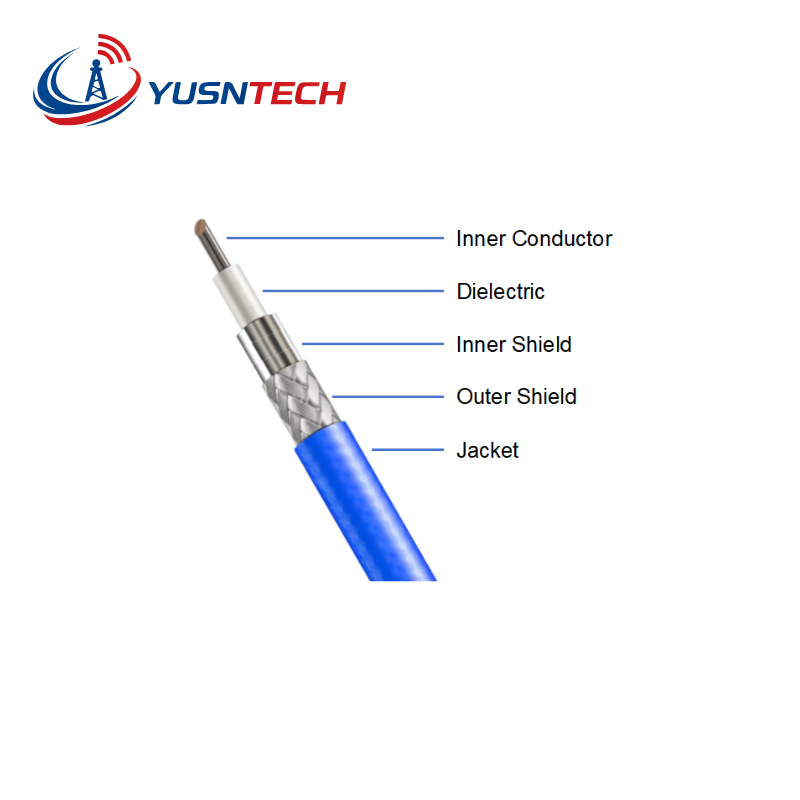
Yusntech Cost-Effective Ultra-Flexible Low-Loss RF Cable Assemblies deliver an ideal combination of flexibility, low insertion loss, and affordability for RF and microwave applications up to 40 GHz. Designed for tight routing and space-constrained installations, these cable assemblies offer excellent shielding performance, reliable signal integrity, and easy integration into wireless communication systems, test equipment, DAS networks, industrial RF devices, and OEM applications. Custom lengths and connector options are available.
Features
- Multi-Core Ultra-Flexible Construction
- Excellent Mechanical Flexibility
- Harsh Environment Resistance
- Stable RF Performance
- Optimized for Complex Routing
Applications
- Armored Vehicle Systems
- Tactical Communication Platforms
- Military RF Equipment
- Compact RF Interconnect Systems
- Precision RF Test Applications
Model↑↓ | Freq. Range (GHz) | VOP (%) | Shielding (dB Min) | DWV (VDC) | Outer Dia. (mm) | Temperature (°C) | Inquiry |
|---|---|---|---|---|---|---|---|
| YSUFLL-800Z | DC-18 | 76% | 90 | 2000 | φ8.00 | -55 to +85°C | Inquiry |
| YSUFLL-500Z | DC-26.5 | 76% | 90 | 1600 | φ5.00 | -55 to +85°C | Inquiry |
| YSUFLL-600Z | DC-26.5 | 76% | 90 | 1800 | φ6.00 | -55 to +85°C | Inquiry |
| YSUFLL-360Z | DC-40 | 76% | 90 | 1000 | φ3.60 | -55 to +85°C | Inquiry |
FAQ
Cost-Effective Ultra-Flexible Low-Loss RF Cable Assemblies are high-performance coaxial cable assemblies designed to provide excellent flexibility, low signal attenuation, and reliable RF transmission at an economical cost. They are ideal for installations requiring tight cable routing, frequent movement, and compact equipment layouts.
Ultra-flexible RF cable assemblies use specially designed cable constructions that allow smaller bend radii and easier routing compared to standard coaxial cables. This flexibility simplifies installation while maintaining stable RF performance and low insertion loss.
Ultra-flexible RF cable assemblies offer easier installation, reduced stress on connectors, improved cable management, enhanced reliability in moving systems, and better performance in confined spaces. They are particularly useful in wireless communication equipment, test systems, and compact RF devices.
These cable assemblies are commonly used in wireless communication systems, DAS networks, antenna systems, RF test equipment, industrial automation, IoT devices, medical equipment, aerospace electronics, and OEM RF integration projects.
Low insertion loss minimizes signal attenuation, allowing more RF power to reach the destination. This improves signal quality, communication efficiency, and overall system performance, especially in high-frequency applications.
Yusntech Cost-Effective Ultra-Flexible Low-Loss RF Cable Assemblies support frequencies up to 40 GHz, making them suitable for RF, microwave, wireless communication, and many advanced electronic applications.
While standard flexible cables provide some bendability, ultra-flexible RF cables are specifically engineered for tighter bend radii and easier routing. This makes them ideal for densely packed equipment, compact installations, and applications requiring repeated cable movement.
Yes. Ultra-flexible low-loss RF cable assemblies are widely used in wireless infrastructure, small cells, Wi-Fi systems, distributed antenna systems (DAS), repeaters, and communication equipment where flexibility and signal integrity are both important.
Absolutely. DAS deployments often require complex cable routing through buildings and infrastructure. Ultra-flexible RF cable assemblies simplify installation while maintaining reliable signal transmission throughout the network.
Modern RF devices often have limited internal space. Flexible RF cable assemblies allow engineers to route cables efficiently around components, reduce installation challenges, and minimize stress on connectors and circuit assemblies.
Shielding effectiveness measures how well a cable protects signals from electromagnetic interference (EMI) and radio frequency interference (RFI). High shielding performance helps maintain signal quality and system reliability in crowded RF environments.
Yes. Their flexibility makes them ideal for RF test benches, laboratory setups, engineering evaluations, and production testing where cables may need to be repositioned frequently.
Yes. Ultra-flexible low-loss RF cable assemblies are commonly used as antenna jumper cables and antenna feed cables in communication systems, wireless networks, and industrial RF installations.
Yusntech can provide ultra-flexible RF cable assemblies with SMA, N Type, TNC, BNC, MMCX, MCX, SMP, 2.92 mm (K), and other industry-standard RF connectors based on customer requirements.
Ultra-flexible cables reduce installation time by allowing easier routing around obstacles, tighter bends, and more efficient cable management. This can lower installation costs and improve overall system reliability.
Yes. OEM manufacturers frequently use ultra-flexible RF cable assemblies because they simplify equipment design, reduce assembly complexity, and support compact product architectures.
Yes. Yusntech offers custom cable lengths, connector configurations, labeling options, frequency optimization, and application-specific designs to meet OEM and system integration requirements.
Industries including telecommunications, industrial automation, medical electronics, aerospace, defense, wireless networking, IoT, transportation, and test & measurement frequently use ultra-flexible RF cable assemblies.
Yusntech combines excellent flexibility, low insertion loss, reliable shielding performance, and competitive pricing to provide RF cable solutions that simplify installation and improve system performance. These cable assemblies are ideal for wireless communications, DAS deployments, industrial RF systems, test equipment, and OEM applications.
Their combination of low signal loss, easy installation, reduced maintenance requirements, and competitive pricing helps lower overall system costs while maintaining reliable RF performance.