
Electromechanical RF Switches: Balancing Insertion Loss, Isolation, and Power Handling
Introduction
RF switches are essential components in modern radar systems, satellite communications, wireless infrastructure, and automated RF test equipment. They control signal routing between different channels, making their electrical and mechanical performance critical to overall system reliability.
However, selecting an RF switch involves more than matching the operating frequency. Insertion loss, isolation, VSWR, power handling, switching speed, and control compatibility must all be considered together.
As RF and microwave systems continue to evolve, engineers are exploring different switch structures and design approaches to achieve better performance and more reliable integration.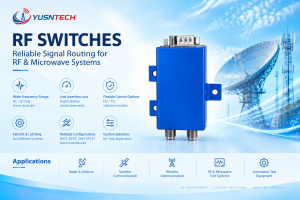
Engineering Insights from Microwave Switch Research
Research into microwave switch design continues to explore ways to improve RF performance while addressing manufacturing complexity and mechanical integration.
For example, a 2021 study published in AEU – International Journal of Electronics and Communications, titled A Broadband Contactless Gap Waveguide Microwave Switch for X- and Ku-Bands Applications, investigated a mechanical waveguide switch using contactless gap waveguide technology.
The research demonstrated that alternative waveguide structures can help address certain manufacturing and assembly challenges while maintaining low insertion loss and high isolation.
Although this design differs from conventional coaxial electromechanical RF switches, it highlights an important engineering principle: RF performance depends not only on the switching mechanism but also on the overall electromagnetic structure, mechanical design, and manufacturing approach.
Four Key Parameters When Selecting an RF Switch
1. Insertion Loss
Insertion loss represents the signal power lost as the RF signal passes through the selected switch path.
In receiver front ends and precision measurement systems, excessive insertion loss can reduce the available signal level and affect the overall system noise performance.
Engineers should evaluate insertion loss across the entire operating frequency range rather than relying on a single typical value.
2. Isolation
Isolation measures how effectively an inactive signal path is separated from the active path.
High isolation is particularly important in radar systems, multi-channel test equipment, and communication systems where unwanted signal leakage may affect measurement accuracy or system operation.
The required isolation depends on signal levels, channel architecture, and the potential consequences of crosstalk.
3. RF Power Handling
Power handling capability depends on the switch design, operating frequency, RF waveform, thermal conditions, and switching state.
For pulsed radar applications, peak power alone is not sufficient for selecting a switch. Pulse width, repetition frequency, duty cycle, and average power should also be evaluated.
A suitable design must satisfy the relevant electrical and thermal limits under the actual operating conditions.
4. Switching Configuration and Control
Different applications require different switching configurations, including SPDT, DPDT, SP4T, and SP6T.
Control voltage, TTL or other logic requirements, latching or normally open operation, connector interfaces, and mechanical dimensions also influence system integration.
Confirming these requirements early can help reduce redesign and integration risks.
YUSNTECH Electromechanical RF Switch Solutions
YUSNTECH provides electromechanical RF switch options for a range of RF and microwave applications, with configurations designed to address different frequency bands, RF performance requirements, and control interfaces.
The product portfolio includes SPDT, DPDT, SP4T, and SP6T configurations, with additional options available across the broader RF switch range.
Depending on the selected model, key specifications may include:
- Operating frequencies extending up to 67 GHz across the product range
- Different insertion loss, VSWR, and isolation specifications
- Multiple control voltage and control logic options
- Normally open and selected latching configurations
- Technical evaluation and customization support for application-specific requirements
Actual performance and availability depend on the individual model. Please consult the relevant datasheet to confirm the operating frequency, RF power rating, control interface, and other critical specifications.
Finding the Right RF Switch for Your Application
The best RF switch is not necessarily the one with the highest frequency rating or the lowest insertion loss in isolation. It is the one that satisfies the complete set of electrical, mechanical, and control requirements of the target system.
When evaluating an RF switch, engineers should consider the complete operating environment, including signal characteristics, switching frequency, thermal conditions, and system interfaces.
At YUSNTECH, we welcome inquiries from RF engineers, R&D teams, OEM customers, and system integrators seeking standard or customized RF switching solutions.
Looking for an RF switch for your next project?
Contact us at sales@yusntech.com to discuss your frequency range, insertion loss, isolation, power handling, control interface, and customization requirements.
Explore our RF and microwave components at https://yusntech.com.