
When temperature changes by more than 220°C, what keeps the RF signal stable?
In aerospace systems, military vehicles operating in extreme climates, outdoor radar installations, and other demanding RF applications, cable assemblies can face dramatic temperature variations.
From freezing environments to high-temperature operating conditions, the question is not simply whether a cable can survive the temperature.
The more important question is:
Can it maintain predictable RF performance throughout the temperature range?
For a high-performance RF cable assembly, temperature stability is not determined by a single material or component. It is the result of coordinated decisions in materials, mechanical structure, RF design, manufacturing, and environmental validation.
For applications requiring operation from -55°C to +165°C, or other specified temperature ranges, these factors become especially important.
1. Why Temperature Changes Affect RF Cable Performance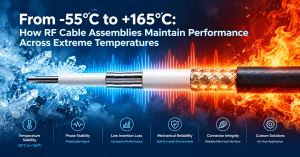
Temperature affects an RF cable assembly in both mechanical and electrical ways.
Mechanical effects
Conductors, dielectric materials, shields, and connector components can expand or contract at different rates as temperature changes.
This can introduce mechanical stress and alter critical dimensions within the RF transmission path.
Electrical effects
These physical changes can influence several important RF parameters:
- Phase stability — changes in electrical length can affect phase and group delay.
- Insertion loss — conductor resistance and dielectric properties can vary with temperature.
- VSWR / return loss — dimensional changes and impedance discontinuities can affect matching.
- Shielding performance — mechanical stress or material changes may affect shielding effectiveness.
For phase-sensitive systems such as phased-array radar, satellite communications, and precision measurement equipment, even relatively small changes can become significant.
The objective of wide-temperature RF cable design is therefore not simply to make the cable “survive.”
It is to control performance variation within the limits required by the application.
2. Material Selection: The Foundation of Temperature Stability
Material selection is one of the first decisions in designing a wide-temperature RF cable assembly.
Dielectric materials
Low-loss dielectric materials such as PTFE, expanded PTFE, and specialized dielectric constructions can provide favorable RF performance over a wide temperature range.
Their dielectric properties and dimensional stability must be considered together because changes in dielectric constant can affect the cable’s electrical length and impedance.
Conductors and shielding
Conductor materials must provide the required combination of:
- Electrical conductivity
- Mechanical strength
- Temperature resistance
- Corrosion resistance
- Flexibility
The thermal expansion behavior of the conductor, dielectric, shield, and connector structure should also be considered as part of the overall cable design.
The goal is to minimize unwanted dimensional changes and mechanical stress across the specified temperature range.
3. Mechanical Design: Managing Thermal Stress
A cable assembly does not experience temperature change as a single uniform material.
Different materials may expand or contract at different rates.
This makes the mechanical transition between the cable and connector particularly important.
A well-designed cable assembly considers:
- Cable geometry
- Dielectric support
- Shield construction
- Connector transition
- Strain relief
- Thermal expansion
- Minimum bend radius
The connector-to-cable transition deserves particular attention.
Poorly controlled mechanical stress can eventually lead to changes in RF performance, connector damage, or reduced reliability during repeated temperature cycling.
For applications requiring both flexibility and temperature stability, the design challenge becomes a balance between:
Mechanical flexibility ↔ RF stability ↔ Environmental durability
4. Manufacturing Matters as Much as the Design
A good design does not automatically produce a good cable.
At microwave frequencies, manufacturing consistency can directly affect RF performance.
Important manufacturing factors include:
- Conductor dimensional control
- Dielectric geometry
- Shield coverage
- Connector assembly
- Cable stripping and termination
- Soldering or other qualified connection processes
- Impedance consistency
- Assembly cleanliness
The specific joining method should be selected according to the cable construction, connector design, frequency range, mechanical requirements, and environmental conditions.
The objective is always the same:
Create a mechanically reliable and electrically consistent RF path.
5. How Do You Verify a Wide-Temperature Cable?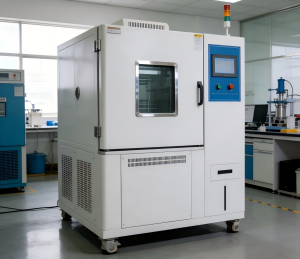
Design assumptions are not enough.
For demanding applications, the cable assembly should be validated under conditions representative of its intended environment.
Temperature cycling
The cable can be exposed to repeated transitions between specified low and high temperatures.
For example, an application may require testing between -55°C and +165°C, depending on the actual system requirements.
Temperature cycling can help reveal problems that may not appear during room-temperature testing.
Real-time RF monitoring
A vector network analyzer can be used together with a temperature chamber to monitor RF characteristics while the cable is exposed to changing temperatures.
Parameters may include:
- S-parameters
- Insertion loss
- Return loss / VSWR
- Phase
- Group delay
- Amplitude stability
This approach provides a direct view of how the RF characteristics change with temperature.
High- and low-temperature dwell testing
In addition to cycling, the cable may be held at specified temperature points for a defined period to verify whether its RF performance remains within the required limits.
The actual test temperature, duration, number of cycles, and acceptance criteria should be defined according to the application and applicable standards.
6. Why Phase Stability Matters in Extreme Temperatures
Among all RF parameters, phase stability can be particularly important for temperature-sensitive applications.
Consider a multi-channel phased-array system.
If different RF paths experience different phase changes as temperature changes, the relative phase between channels can shift.
That can affect:
- Beamforming
- Direction finding
- Calibration
- Timing
- Measurement accuracy
- System repeatability
The same principle applies to precision test systems and satellite communication equipment.
A temperature-stable cable therefore helps maintain a more predictable electrical reference between connected RF components.
7. Wide-Temperature Performance Is a System-Level Requirement
It is tempting to look at the cable’s temperature rating as a single number.
But real-world reliability is more complicated.
A cable assembly’s temperature capability depends on the complete structure:
Conductor + Dielectric + Shield + Jacket + Connector + Termination + Manufacturing Process
The weakest element can determine the actual operating capability of the complete assembly.
This is why wide-temperature RF cable design should be approached as a system-level engineering problem, rather than simply selecting a high-temperature jacket material.
8. YUSNTECH Wide-Temperature RF Cable Assemblies
At YUSNTECH, we develop RF coaxial cables and cable assemblies for applications where electrical performance, mechanical reliability, and environmental stability must be considered together.
Depending on the application, we can customize cable assemblies according to requirements such as:
- Frequency range
- Insertion loss
- Phase stability
- VSWR / return loss
- Cable length
- Flexibility
- Minimum bend radius
- Connector type
- Operating temperature
- Temperature cycling requirements
- Mechanical and environmental conditions
For applications requiring operation across wide temperature ranges, the cable construction can be evaluated according to the actual system requirements rather than relying only on a standard cable configuration.
Typical application areas include:
Radar | Aerospace & Satellite | Defense Electronics | RF Test & Measurement | Outdoor Communication Systems | Automotive Radar
From prototype development to volume production, our goal is to provide RF interconnect solutions with predictable electrical performance and application-specific environmental reliability.
Conclusion
For an RF cable assembly, extreme temperature is not simply a test of material endurance.
It is a test of the entire engineering chain.
Materials determine the foundation.
Mechanical design controls thermal stress.
Manufacturing determines consistency.
Testing proves whether the design works.
When the operating environment spans from -55°C to +165°C, maintaining RF performance across more than 220°C of temperature variation requires much more than a high-temperature jacket.
It requires the entire cable assembly to be designed and validated as an RF system component.
When the environment changes, the signal path should remain predictable.
YUSNTECH — RF & Microwave Components
RF Cable Assemblies | Phase-Stable Cables | Wide-Temperature RF Solutions