
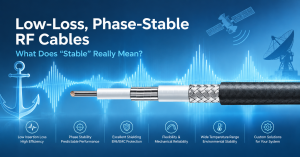
Low-Loss, Phase-Stable RF Cables: What Does “Stable” Really Mean?
In RF and microwave systems, a cable is often treated simply as an interconnection between two components.
But in applications such as phased-array radar, satellite communications, aerospace systems, and precision test and measurement, the cable can become part of the system’s measurement and signal integrity chain.
A small change in insertion loss, impedance, or phase can affect the accuracy and repeatability of the entire system.
This is where low-loss, phase-stable RF cables become important.
But what exactly does “phase-stable” mean?
And where does the stability actually come from?
1. Phase Stability: The Core of a Phase-Stable Cable
The most important characteristic of a phase-stable RF cable is, naturally, phase stability.
In multi-channel RF systems, signals often need to maintain a predictable phase relationship with one another.
This is particularly important in applications such as:
- Phased-array radar
- Satellite communications
- Aerospace and defense systems
- RF calibration systems
- Vector network analyzer test setups
- Precision measurement equipment
A conventional RF cable may experience changes in electrical length when it is bent, twisted, or exposed to temperature variations.
These changes can result in phase variation.
For a phase-critical system, the issue is not simply whether the signal can reach the other end of the cable.
The real question is:
How much does the phase change when the cable is moved, flexed, or exposed to temperature variations?
A phase-stable cable is designed to control these variations through the combination of:
- Conductor construction
- Dielectric material
- Dielectric geometry
- Shielding structure
- Mechanical reinforcement
- Controlled manufacturing processes
The objective is not to make phase completely independent of all conditions.
Rather, it is to minimize and control phase variation within the specified operating conditions.
That distinction is important when evaluating a phase-stable cable.
2. Low Loss: More Than Just Preserving Signal Power
Phase stability is only one part of the equation.
For high-frequency systems, insertion loss is another critical parameter.
As frequency increases, conductor loss, dielectric loss, and other transmission effects become increasingly important.
A low-loss RF cable is designed to minimize these losses and maintain predictable transmission performance across its specified frequency range.
Typical parameters engineers may evaluate include:
- Insertion Loss
- Return Loss / VSWR
- Characteristic Impedance
- Phase Stability
- Amplitude Stability
- Frequency Range
- Power Handling
A good RF cable should therefore provide not only low attenuation, but also consistent impedance and predictable RF behavior.
This becomes particularly important when cables are used in measurement systems, calibration paths, and multi-channel RF architectures.
3. Mechanical Stability: What Happens When the Cable Moves?
One of the biggest differences between a standard RF cable and a phase-stable cable is how the cable behaves under mechanical stress.
When a cable is bent, the physical geometry of the conductors and dielectric can change.
That can change the electrical length and therefore the phase.
This is why phase-stable cable design pays close attention to mechanical construction.
Important considerations may include:
- Minimum bend radius
- Repeated flexing
- Tensile strength
- Shield construction
- Dielectric stability
- Connector-to-cable transition
- Strain relief
For applications such as portable test equipment, radar assemblies, antenna systems, and instrumentation, the cable may be moved repeatedly during operation or testing.
In these situations, the cable must be designed so that mechanical movement produces only a controlled change in RF characteristics.
4. Environmental Stability: Temperature Matters
Temperature is another major factor affecting RF cable performance.
Changes in temperature can cause materials to expand or contract.
This may change the physical dimensions and dielectric properties of the cable, which can in turn affect electrical length and phase.
For phase-sensitive applications, engineers may therefore specify parameters such as:
- Phase stability vs. temperature
- Amplitude stability vs. temperature
- Operating temperature range
- Thermal cycling performance
This is particularly relevant in aerospace, outdoor communications, radar, and other systems exposed to significant temperature variations.
A well-designed cable does not simply aim to operate across a wide temperature range.
It aims to maintain predictable RF characteristics across the specified temperature range.
5. Why Phase Stability Matters in Real Systems
The importance of phase stability becomes easier to understand when looking at actual applications.
Phased-Array Radar
Multiple antenna channels need predictable phase relationships to form and steer beams accurately.
Cable-to-cable phase differences can therefore become part of the overall system error budget.
Satellite Communications
Stable RF interconnects help maintain predictable signal paths within RF front ends, converters, and antenna systems.
Precision Test & Measurement
In vector measurements, calibration systems, and high-frequency instrumentation, cable movement can introduce measurement uncertainty if the cable’s phase characteristics change significantly.
5G and Millimeter-Wave Systems
At higher frequencies, even relatively small changes in electrical length can correspond to significant phase changes.
This makes cable construction and mechanical stability increasingly important.
6. What Makes a Good Phase-Stable RF Cable?
There is no single construction that is optimal for every application.
The appropriate cable design depends on the required frequency range, phase stability, loss, flexibility, temperature range, mechanical environment, and connector configuration.
A typical evaluation may include:
Electrical Performance
- Low insertion loss
- High return loss
- Controlled impedance
- Stable phase characteristics
- Stable amplitude characteristics
- Appropriate power handling
Mechanical Performance
- Controlled bend radius
- Flexibility
- Repeated flexing capability
- Mechanical reinforcement
- Connector retention
Environmental Performance
- Operating temperature range
- Thermal stability
- Temperature cycling
- Moisture and environmental resistance, where required
The important point is that phase stability is not created by a single material or component.
It comes from the interaction between cable materials, geometry, mechanical construction, manufacturing process, and quality control.
7. YUSNTECH Phase-Stable RF Cable Solutions
At YUSNTECH, we develop and manufacture RF coaxial cables and cable assemblies for demanding RF and microwave applications.
For phase-sensitive applications, we can support customized cable solutions based on requirements such as:
- Frequency range
- Insertion loss
- Phase stability
- Amplitude stability
- Cable length
- Cable diameter
- Minimum bend radius
- Operating temperature
- Connector configuration
- Mechanical environment
Depending on the application, cable constructions can be optimized for low loss, phase stability, flexibility, ruggedness, or a combination of these requirements.
We also support customized RF cable assemblies for applications including:
Phased-Array Radar | Aerospace & Satellite | RF Test & Measurement | Microwave Communications | 5G / Millimeter-Wave Systems
From engineering samples to volume production, our goal is to provide RF interconnect solutions with predictable and repeatable performance.
Conclusion
So, where is a phase-stable cable actually “stable”?
Not simply in one specification.
Its stability is reflected in how consistently it maintains its RF characteristics when conditions change:
When the cable bends.
When the temperature changes.
When the cable is installed and moved.
When the system operates at higher frequencies.
That is the real value of a phase-stable RF cable.
A good RF cable does more than carry a signal.
A phase-stable cable helps preserve the relationship between signals.
If you are looking for low-loss, phase-stable RF cable assemblies for radar, aerospace, satellite communications, precision measurement, or other high-frequency applications, contact YUSNTECH to discuss your requirements.