
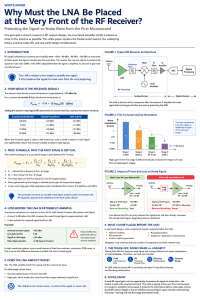
 When engineers discuss RF receiver architecture, one design principle is almost universal: the Low Noise Amplifier (LNA) is placed as close to the antenna as possible.
But why?
Why can’t we filter first, mix first, or simply amplify the signal later?
The answer is surprisingly simple: a weak RF signal gets only one opportunity to preserve its signal-to-noise ratio (SNR). Once that SNR is degraded at the receiver front end, no amount of amplification or digital processing can fully recover it.
The Real Job of an LNA Isn’t Just Amplification
Many people assume that an LNA is simply an amplifier with low noise.
In reality, its mission is much more important.
An LNA boosts the extremely weak signal received by the antenna while adding as little noise as possible. It does this before the signal passes through mixers, filters, ADCs, and other receiver stages that inevitably introduce additional noise.
In other words, the primary purpose of an LNA is not to create a stronger signal—it is to preserve the signal-to-noise ratio from the very beginning of the receive chain.
How Weak Is an RF Signal?
Signals arriving at a receiver antenna are often astonishingly small.
Typical received signal levels include:
- –80 dBm
- –90 dBm
- –100 dBm
- or even weaker
At these levels, the received signal is already approaching the thermal noise floor.
The thermal noise density at room temperature is approximately:
–174 dBm/Hz
For a receiver bandwidth B, the thermal noise power is approximately:
Noise Power = –174 + 10log(B)
Adding the receiver’s own Noise Figure (NF) determines the overall receiver sensitivity.
Ultimately, receiver sensitivity depends on one critical question:
How much additional noise does the receiver front end introduce before useful amplification occurs?
Friis’ Formula Explains Everything
The importance of the first stage can be described by the famous Friis cascade noise figure equation:
F_total = F₁ + (F₂ – 1)/G₁ + (F₃ – 1)/(G₁·G₂) + …
Although the equation looks intimidating, its message is remarkably simple:
- The noise figure of the first stage dominates the entire receiver.
- Noise generated by later stages is divided by the gain of the stages before them.
- A low-noise, high-gain LNA effectively suppresses the noise contribution from mixers, IF amplifiers, and ADCs.
This principle is why RF engineers pay so much attention to the first active device in the receiver chain.
Why Loss Before the LNA Is So Harmful
One of the most common mistakes in RF front-end design is placing excessive loss before the LNA.
Suppose an RF switch, PCB trace, connector, or filter introduces 1 dB of insertion loss before the amplifier.
That 1 dB is far more damaging than it appears.
It not only reduces signal power—it also increases the receiver’s overall noise figure by approximately 1 dB, directly degrading receiver sensitivity.
For example, imagine the antenna receives a –100 dBm signal.
If components ahead of the LNA introduce 2 dB of loss, the signal entering the amplifier becomes –102 dBm. More importantly, the receiver’s effective noise figure also increases by roughly 2 dB, making weak signals significantly more difficult to detect.
This explains why experienced RF designers often say:
Every fraction of a decibel lost before the LNA is almost impossible to recover later.
Why the LNA Is Installed Close to the Antenna
This is why LNAs are typically positioned as physically close to the antenna as practical.
The goal is not simply shorter PCB routing.
The goal is to amplify the desired signal before unnecessary losses and additional noise can degrade the signal-to-noise ratio.
In high-performance low-noise receivers, even 0.5 dB of extra insertion loss ahead of the LNA can noticeably reduce sensitivity.
Does an LNA Remove Noise?
A common misconception is that an LNA amplifies only the signal.
It doesn’t.
The LNA amplifies both the signal and the noise that arrive at its input.
Its advantage lies elsewhere:
- It introduces very little additional noise of its own.
- It provides enough gain that the noise generated by later receiver stages becomes relatively insignificant.
Therefore, an LNA does not eliminate noise.
It protects the signal-to-noise ratio, which is ultimately what determines whether a receiver can successfully detect weak signals.
Can Anything Be Placed Before the LNA?
Yes—but only when necessary.
Practical RF receivers often include components ahead of the LNA, such as:
- Antenna switches
- ESD protection circuits
- RF limiters or lightning protection
- Preselection filters
- Duplexers or diplexers in transceiver systems
Each of these components introduces some insertion loss.
Consequently, RF front-end designers always strive to minimize both the number of components and their associated losses before the LNA.
The Trade-Off: Noise Figure vs. Linearity
If placing the LNA first is so beneficial, why isn’t every receiver designed that way without compromise?
Because receiver design is always a balance.
Strong nearby transmitters or blockers can push an LNA into compression or generate unwanted intermodulation products.
Therefore, engineers must consider not only:
- Noise Figure (NF)
- Gain
but also:
- P1dB (1 dB Compression Point)
- IP3 (Third-Order Intercept Point)
- Blocking performance
- Dynamic range
An LNA with the lowest possible noise figure is not always the best choice if its linearity cannot withstand real-world interference.
The Fundamental Design Principle Never Changes
Every RF receiver is a compromise between:
- Low noise
- High gain
- Excellent linearity
- Strong blocking immunity
- Receiver sensitivity
However, one principle remains constant:
The receiver front end determines the signal-to-noise ratio, and the first active stage largely determines the overall cascade noise figure.
That is why the LNA almost always belongs at the very front of the receiver.
Conclusion
A weak RF signal gets only one opportunity to preserve its signal-to-noise ratio—the instant it enters the receiver.
If that signal suffers unnecessary loss before the first amplification stage, its information content has already been compromised. No amount of additional gain, filtering, or digital signal processing can fully restore what has been lost.
For this reason, the LNA is positioned as close to the antenna as practical. Its purpose is not simply to make the signal larger, but to protect the receiver’s most valuable asset: signal quality before noise takes control.